Sunday, 15 July 2012

Colegio San Pedro

On Friday 13th we visited Colegio San Pedro, (the school in La Molina that initially inspired the project) and met with Esteban Navarra, the man who co-ordinated the construction of their fog collectors.

The project began in 2002 as a way of augmenting the water supply to the school as it was expanding and water was very expensive. There are 28 mesh screens, each measuring 6 m x 10 m and all in one row along the top of the hill, connected to one pipe that runs all the way along. It took 4 months to build the lot!

Check out the greenery in the school grounds- it's normal for us in Australia right? But we hadn't seen grass like this since arriving over a week ago! It's especially striking against the rocky dirt hills that the school is built into.


The screens are usually rolled up to protect them from the sun and dirt during summer, then unrolled in May to collect fog. However, Esteban said they hadn't been unrolled in 4 years due to El Niño and the lack of sufficiently dense fog- and the meshes had been taken down and used in the chicken coops instead! But when the atrapanieblas are in use they collect about 40 m^3 per week (all together) and the water is used to water the 50 000 m^2 of lawns and gardens at the school!

Construction Complete! (well, very nearly)

Miercoles 11 Julio (Wednesday 11th of July)

Construction has begun! Following two days of material gathering in the “black market”, a truck hired for 80 Soles sufficed to bring all the materials and ourselves up through the shanty town as close as a vehicle can possibly get to our chosen site. The journey up and through the shanty town’s dirt roads was extremely bumpy. There was a point where the truck was confronted by an oncoming car but the road was only the width of one and a half lanes. The driver had to turn the truck onto the angled cliff face for the car to barely fit through. It reminded me of the Top Gear Bolivian special (for those who have seen it), but luckily we were on the inside “lane”.


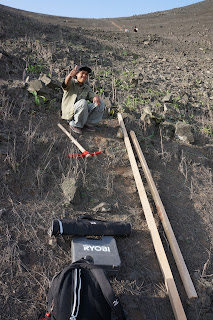
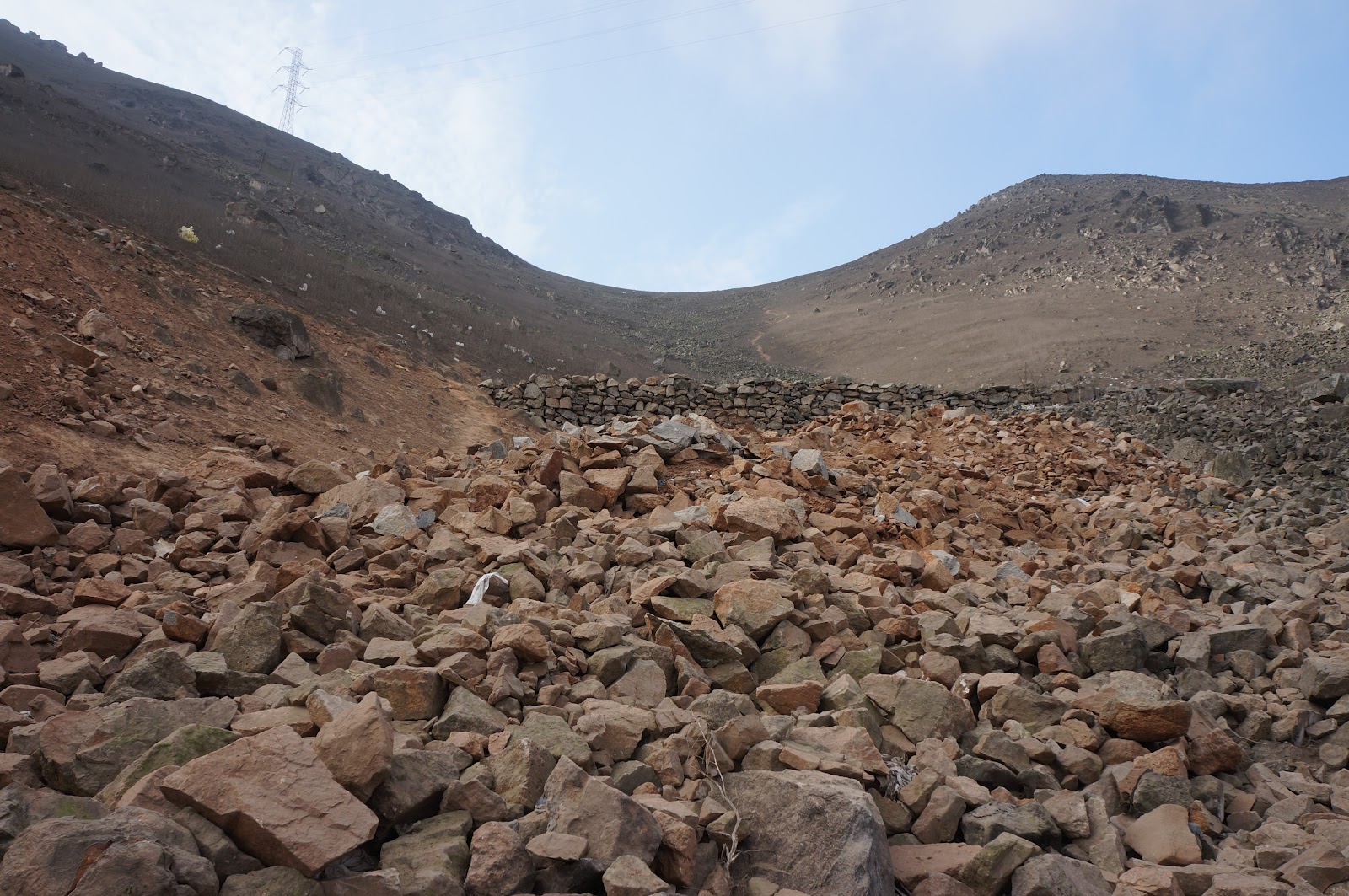
We were to construct our systems at a location towards the peak of the hill. This hill has since become known as the hill of pain. Just walking up to the site without carrying anything burns and rips your quads, hammies and calves to bits. We had to carry up several planks of wood (the largest being 4 m x 0.1 m x 0.05 m), tools, bags of cement and aggregate, buckets of water and 0.15 m diameter pvc pipes up some of the steepest slopes that was very susceptible to slipping and falling over. The base of the slope is filled with rubbish left by the locals and also toilet paper and faeces (only dogs' I hope, but then I think about lack of sewerage systems). Sharp angular rocks fill portions of the surface. The rest is filled with dirt, dried branches from tiny plants and specks of vegetation. Luckily the locals have been very helpful, two of them putting their hands up to help us carry the materials and construct. One in particular, named Freddy, carried bags of cement and aggregate on his shoulder up the slopes as I struggled behind with a back pack, drill pack, shovel and pick. I kept repeating to him that “Freddy es muy forte!” 


As the material was slowly carried up after repeated killer trips, we began to dig up holes 0.5 m deep for the foundation of the two main posts for the SFC. Also, the main frame was prepared by cutting four 0.1 m smaller timber members and attaching them to the main posts and screen vertical members. At first, we tried to screw through the large posts into the 0.1m cross members. However, the timber proved to be too strong so drill bits were used together with hammer and nail. Freddy powered through and eventually attached the four cross members to the main posts and the screen frame vertical members.


It was late afternoon and time to erect the frame as it was decided the mesh would be attached in the morning and it was more important to allow the concrete to dry. The two dug up holes were set 1.5m apart and required the use of concrete and large rock aggregates to fill up the holes as the posts were put in place with the aid of a spirit level. This was to conclude day 1 of construction as the sun set.  


Jueves 12 Julio (Thursday 12th of July)

We were to meet the locals who volunteered to help us at 8:30. However today, we had no one to accompany us to the site and it was a new challenge to make it there without this help. Normally the trip would involve at least two bus rides and possibly a taxi (it has varied because of being brought up by different people whom work at different locations during the day). Luckily we found our way without any issue except the initial worry.

We reached the site and one of the local ladies fetched our two handy workers, Lister and Freddy. Firstly, we needed to cut the 4 m long, 0.15m diameter PVC pipe in half longitudinally using an electric power saw. However, we needed to find electricity. This required 4 extension cords from one of the shack houses but eventually the job got done. Lister and I proceeded to carry the rest of the timber posts, tools and pipe up the hill to the site and it was one of the hardest things I’ve done physically. I thought I was decently fit and fairly strong with my routine 3 km treadmill run and weights session 2-3 times a week back home, but was humbled by Lister and Freddy’s strength in bringing up more bags of cement, aggregate, buckets of water and a huge timber ladder. 


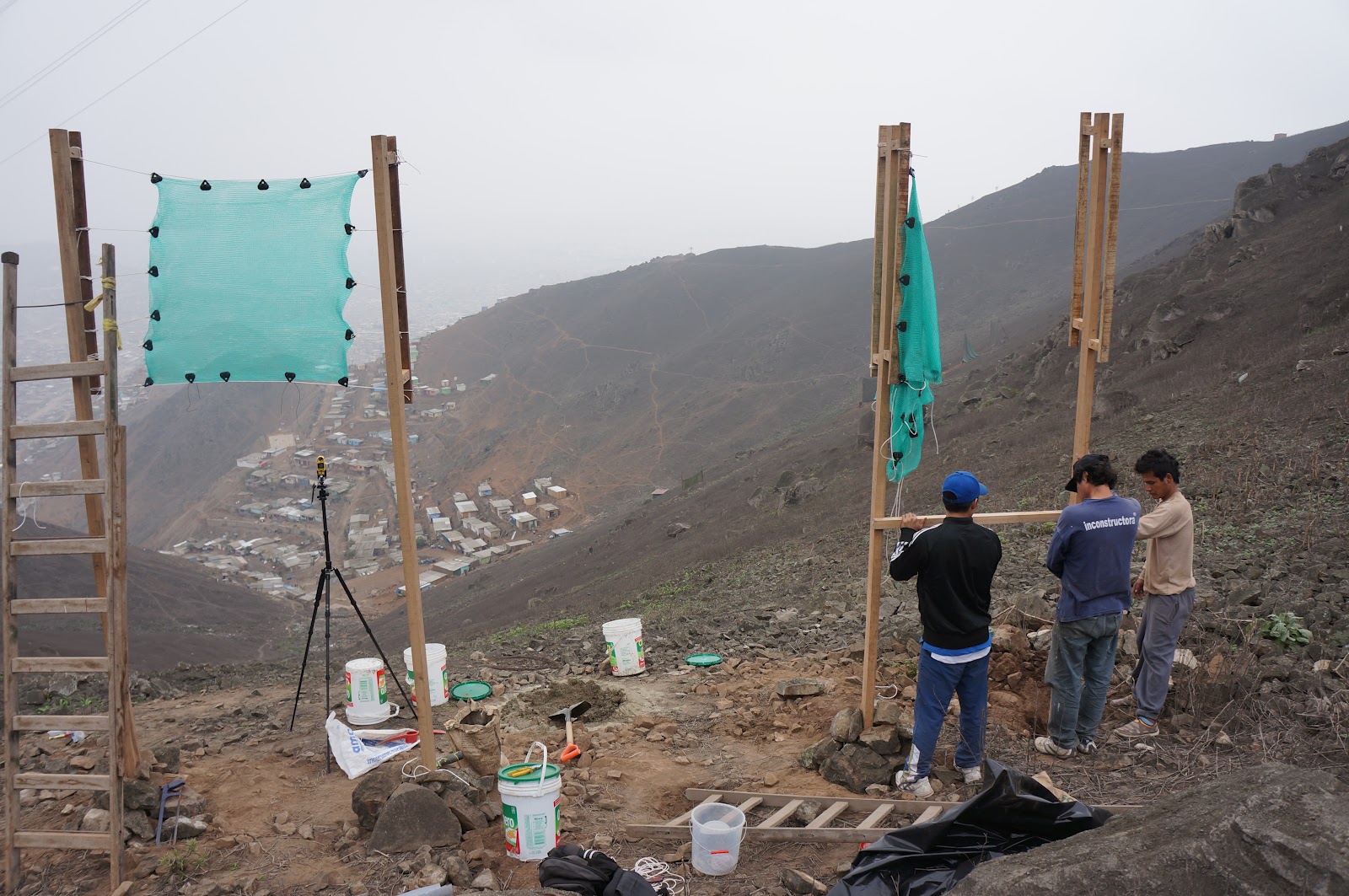
When everything was bought up, the second frame was put together, similar to the SFC but now with a symmetric 3D design. Again holes were dug and concrete prepared as Catherine worked diligently putting together the mesh screens and attaching it to the SFC. This involved using mesh clips around the screen’s perimeter and tying it to the frame using lots of rope and metal cable ties. The decision was made to attach the 3d mesh screen to the frame on the ground prior to erecting the posts to eliminate the need for going up with the escalada (ladder).


However we realized that installing the troughs would require going up anyway. The troughs were attached using more metal wire ties. Cath has become an expert at tying from this experience. The next step was to work on piping, connecting the trough to a thin hose. However, the sealant gun that we had purchased quickly broke so we could not put the connections together. We decided to use a heap of metal ties again to secure buckets right underneath the end of the trough as shown in the photos.


Thursday, 12 July 2012

Sparrows


Martes 10 Julio 
Luis, biologist and fog collecting guru from PEBAL
Starting at 4:30 am on Tuesday morning, Andy, Victor and I made our way to the bottom of the shanty town to meet with our new found friend Luis. From there we got a mini-van halfway up the hill, and trekked the rest of the way up to where the fog collectors were, above Flor de Amancaes.

Luis had the key to the little shack where the water tanks are kept and opened it up for us. There were two 150 Litre tanks there, the second connected to the first as an overflow reservoir. Luis mentioned there were problems with particulates because of all the dust, but sedimentation was pretty effective at cleaning it. The water itself he said was pure, but having been stored in a tank for a day or two couldn’t guarantee that it would be safe to drink- so the locals only use it for washing clothes and watering plants. On the other side of town is Villa Maria Triunfo, the site of another fog collection project. Here the air is polluted with contaminants and heavy metals due to the vast amount of cement and concrete used, and this has contaminated their fog water as well.

We left the shack and climbed the steep, dusty slope further. Luis had thought the best place for us to set up our structure was on the same hill as PEBAL’s one, but a couple of hundred metres higher and to the east, halfway between two hills. He assured us that this place was the most accessible of all the suitable spots!!

We reached the top as the sun was coming up, and set up the Kestrel on a spare bit of wood since we’d forgotten the tripod! We wanted a couple of hours of data so while we waited I sat with Luis and tried to get some questions answered, but my Spanish first thing in the morning…hmm…

The screens that we had previously thought to be abandoned are actually functioning very well, especially during April, May and June. We thought they were dirty, but turns out that there’s a couple of young guys in the community who are paid 5 soles/ month to clean out the troughs every week. Every six months they take down the meshes completely and wash them with water and detergent.

Who needs a tripod anyway??
We were less impressed to be informed that the heaviest fog is actually at about 9-10am, and this was verified over the morning as the fog rolled in and thickened as the sun rose. Who told us it was 5am??? Haha but we were relieved to find we don’t need to worry about taking wind speed measurements so early in the morning!


On the way back down the hill we stopped to check out PEBAL’s pilot project, an 8m2 mesh now covered in algae but nevertheless collecting water!!


Coming soon- our trip to the mercados negros (black markets) and construction!! But for now I’m pretty keen to sleep, buenas noches muchachos!

Wednesday, 11 July 2012

A new perspective


For those who did not know, Catherine has previously made a trip to Lima in 2010 for volunteer work where she had worked in the Shanty Towns. I will provide a perspective of somebody visiting San Juan de Miraflores in Lima and being confronted by the Shanty Towns in Pamplona Alta for the first time.

Driving outwards from Lima, you observe vast spans of buildings half complete with exposed steel reo bars protruding out from slabs and columns. The locals do this because it gives them the option to extend their houses another floor if they want to upgrade or as their families become larger in the future but can not afford to do so now. At first, I thought that these households were amongst the poorest. In fact, they are amongst the norm and their residents are considered to live comfortably. They are connected to the water and electricity supply and there is little need for a household vehicle as transport is widely available in the form of taxis, the equivalent of tuk tuks, buses and public mini-vans. The road infrastructure is also quite good to cater for the vehicles. The main issue I observe is the pollution due to suspended debris and fumes emitted from the vehicles.


The poorest are found in the shanty towns. They are not difficult to spot from a distance. An array of colourful matchbox looking structures separated by the arid land cover the hillsides on the outskirts of the city. As you approach, the tarmac disappears and a bumpy ride ensues. 


We hop off the taxi, they’re generally reluctant to go through the shanty town any further. On foot, the ground is either mud, dirt, dog poop, rubbish or aggregate. It is extremely dusty as trucks and mini vans drive through the dirt roads. The smell is a mix of dog faeces, urine, rubbish and used soapy water. At times it is close to unbearable. There are dogs everywhere constantly barking, some wailing with a lack of energy. A lot of them are diseased and dirty, wounds are clearly visible. You pity them. Then you approach a child who is weeping alone on a flight of concrete stairs that have been constructed by volunteer workers. Her clothes and skin are also visibly dirty. You ask how she is and she replies that she is ill. You wonder where her mother is. All you can do is offer a smile of encouragement. You proceed and then you see another... and another... Words can not describe the feeling. You proceed further and find girls washing their hair from tubs on the side of the road. Their drainage system is the bare earth. You quickly realize that they would also not have a sewerage system.


It is surreal when you come from a place where basic sanitation is so trivial. You never really think twice about it. Imagine living without running water, proper drainage or sewerage. I wonder if you can (yes, stolen from John Lennon lol). We have since found out that purchasing water from trucks takes up more than 5% of a family’s income (which works out to be around USD 2 per person per day) and that they use it very sparingly because it is so expensive, being charged more than 5 times the price of water that is distributed through the main water supply. The locals have responded very positively towards fog collection stating that they have used an existing system’s water for irrigation and to wash clothes. This is very encouraging and shows that the technology has already helped alleviate some of the burden from not having proper access to the most fundamental resource for human life.

Tuesday, 10 July 2012

Día 2

Lunes 9 Julio 
On Monday we made it our mission to talk to the people at PEBAL (Programa de Educación Básica Laboral) who had set up those four fog collectors in November 2011. We really wanted their advice about where to set up ours and were interested to know how they chose their site.


We took a mototaxi to their headquarters in San Juan de Miraflores and were told that the director was in a meeting all morning, and that she was very busy and important. We had some questions prepared and with Victor's help added more while we waited in the courtyard. As soon as the director left the meeting Victor jumped up and quickly told her all about our project in the hope that she would make time to talk with us later in the day. He ran back over to us yelling "ahorita vamos vamos vamos!" ("Now!! Let's go go go!!) and we hurriedly followed the director, Ofelia Montes López, into her office.


We (well, mostly Ofelia and Victor) spoke for about 20 minutes about the fog collection project. Being the director of the whole organisation Ofelia wasn't directly involved in the technical side of the pilot project, but she knew a lot about the shanty town in general.


Ofelia told us that: 
  • 80% of the shanty town's inhabitants were living on private property, and the other 20% on government owned land. 
  • There are 3 main risks for the shanty town's inhabitants (pobladores)
    1. Fire: The house are (poorly) constructed mostly of timber and there are sometime accidents when food is cooked over a gas stove or open fire
    2. Sanitation: Because there is no running water there are lots of problems with hygiene, especially in regard to toilets.
    3. Falling rocks: The hills are covered in loose rocks, gravel and dirt that sometimes fall and damage the houses (and injure people). Peru is also prone to earthquakes (at least one big one every 25 years) making this problem even worse.
  • It would cost 1.6 Billion Soles (AU $596 Million) to solve the water problem in various parts of Lima by 2017.
Luis Huaman, a biologist who works with PEBAL, then joined our meeting. He worked on the fog collection project and knew a great deal about the technology- even quoting the same reports we had read for our literature review! Luis was really interested in our project and was keen to be involved, saying he would help in anyway he could. His pilot project was barely a year old, and was collecting less water than they had expected (only 1L/m^2/day compared with 5L/m^2/day in Villa Maria Triunfo- a nearby shanty town) so he was very encouraging of our desire to improve on existing designs.

We made a plan to visit a site that he thought would be good for our investigation first thing in the morning (at 5am- when there is apparently the most fog) and that he could help us update our plan of attack afterwards.

I was so stoked that we had found Luis, his personal experience with such a similar project is invaluable and his generosity and readiness to help was incredible. We're really looking forward to working with him! 


Monday, 9 July 2012

Lima: Día 1

Hola a todos! So we're pretty well settled in Lima now, over our jet lag and getting stuck in! Being such obvious foreigners, everyone's always asking us why we're here in Peru- and when we describe the project we get such a positive response which is really encouraging!
So, what have we been up to?

Viernes 6 Julio

On Friday we visited the shanty town Pamplona Alta in San Juan de Miraflores. We walked for about an hour through the shanty town past chancherías (pig sties), houses and comedores -places that serve food very cheaply- for babies, children, or adults- Un sol cincuenta  centimos or less (45 cents). The ground was rocky and dirty, we had to avoid piles of rubbish, decaying animals and dog poo and not fall over. There were lots of very steep escaleras (stairs) that we had to climb. Far in the distance we saw a group of 4 fog collector screens, high up above the houses, and decided to go and check it out. It took ages to walk, and was really smelly and gross, especially with the sun (but still overcast). There were also piles of burning rubbish, and old people picked through the garbage trying to find useful or valuable things, or food.


We navigated the unstable ground and trekked up the steep ‘cerro’ (hill) towards the fog collectors, stopping frequently to rest and choose the best path. Once we got to the fog collectors the view was incredible- we could see all the way to the coast (about 30 km away) and looked down on the sprawling shanty town below.

Then it was time to investigate the fog collectors. We started off taking photos of everything: the whole structures and their details, talking about the materials, comparing it with our one and those we had researched. It had wooden support posts, two layers of mesh and a pvc gutter. There were mesh clips all the way along it to hold the ropes that attached it to the posts and the trough. It was covered in dirt, and the trough was lined with dust. One of the fog screens had broken and lay decrepit on the hillside. We were expecting to build our standard fog collector (SFC) with an aluminium frame, but Victor explained that aluminium is more expensive than wood, and because it’s valuable people might want to steal it and sell it, so we’ve changed our design to accommodate this.


We were excited to find lots of greenery- some weedy ground cover that indicated ‘tierra dulce’ or fertile soil. Victor explained that these plants survived on the moisture in the air. When we picked up handfuls of dirt they were full of little roots, and had a decent moisture content.


We set up the Kestrel 4500 (donated by Prospectors) on Andy’s tripod (donated by Fotogenic) to check out the wind speed and weather conditions, but being the middle of the day there was barely any fog or wind! From now on we’ll be going to site much earlier when the fog is still present (hello 4.30am starts!)With the help of Victor's laptop and Nextel's internet coverage, we found out that the fog collector was a pilot project done by PEBAL, an organisation much like Solidaridad En Marcha (for which Victor is the volunteer coordinator). Next week we're going to meet with the director of PEBAL and ask about this project- it's successes and failings, how they chose the site, and learn as much as we can from their experience before starting ours.


On our way down we stopped to chat with a lady, Lidia Pancheco, who lived closest to the fog collector and was washing her clothes outside her house with a neighbour. She said the collector works well and she uses the water for washing clothes and watering her plants (there were some saplings growing quite well along the side of her house). We also asked her about the water in barrels- she has to buy a barrel water every second day (at about 2.50 soles per barrel- super expensive) from the tanker-truck that comes around the cerros. The attitude towards the fog water was positive - Lidia thought the water seemed more natural. Her son quipped that he didn’t like the taste of the tank water, but the fog water wasn’t currently being used for drinking.


Wednesday, 4 July 2012

Press

After a 12 hour flight and 10 hour stopover, Andy and I are chilling in Santiago airport waiting for our flight to Lima... soon...in the meantime checkout some local press the project's getting!

http://hills-shire-times.whereilive.com.au/news/story/hills-student-flies-to-peru-to-catch-fog/

Looking forward to blogging when we get started in Lima!